

Have you built, bought or want to convert a building and are wondering whether someone holds copyright in it? The first question to answer is: is the building a copyrighted work at all? Not every house, hall or office building enjoys the protection of the Copyright Act. What decides is whether the building is a unique result of the architect's creative activity - and it is precisely this boundary that often determines whether the architect can have a say in your renovation or not.
In this article we explain which buildings and architectural works are protected by copyright, what protection specifically covers, and when a building is not a copyrighted work. At Preegal law firm we connect intellectual property law with real estate and construction practice, so this question is part of our everyday agenda.
When is a building a copyrighted work? The condition of uniqueness
The Czech Copyright Act (Act No. 121/2000 Coll.) expressly lists an architectural work, including an urban-planning work, among protected works. But it is not enough that something comes into being as a building - to be a copyrighted work it must meet the general features of a work under Section 2 of the Copyright Act. A work must be a unique result of the author's creative activity and must be expressed in any objectively perceptible form.
The key is the condition of uniqueness, understood in practice as a requirement of individuality or originality - the work must bear the author's creative signature, their distinctive architectural or urban-planning solution. The purpose, extent, significance or artistic value of the building is not decisive: a gallery may be protected just as much as a family house, provided they are the result of creative work. Conversely, neither a high price nor the size of a building makes it a copyrighted work if creative individuality is missing.
What is and is not protected? The idea versus its expression
Copyright protects the specific expression of a work, not the idea behind it. In architecture this has entirely practical consequences. Protection covers not only the completed building but also the way the architectural work is expressed - the study, design, drawing, plan or model. Protection therefore arises already at the project stage, long before construction begins.
By contrast, the following remain outside protection:
- the mere idea, concept or architectural notion, until it is creatively rendered,
- functional and layout solutions dictated by the purpose of the building or by technical requirements,
- structural principles, construction methods and technical solutions (these may possibly be protected by industrial property rights, for instance a patent, but not by copyright),
- elements prescribed by standards or legal regulations, where the architect has no creative freedom.
The distinction between the idea and its expression also plays a key role in disputes over inspiration and imitation. We look at where permitted inspiration ends and interference with copyright begins in the article Copying a work is not inspiration.
Typical examples: when a building tends to be a copyrighted work and when not
The boundary between a protected and an unprotected building cannot be drawn across the board, but practice offers fairly clear typical examples on both ends of the scale.
A copyrighted work will usually be:
- an individually designed villa, family house or apartment building with a distinctive architectural expression,
- a public or representative building - a gallery, theatre, museum, or headquarters with distinctive architecture,
- an urban-planning solution of an area, a square or a public space,
- an architectural study or competition design with a creative solution.
A copyrighted work will usually not be:
- an ordinary standardised hall, warehouse or simple industrial structure without creative treatment,
- a catalogue family house built from a standard project without individual modifications,
- an ordinary engineering structure whose form is fully determined by its technical purpose,
- minor or purely functional objects without an architectural solution.
Between these poles lies a grey zone where the outcome is decided by the degree of creative individuality in the specific solution. It is precisely here that an expert assessment pays off - especially before a purchase, renovation or demolition.
![]()
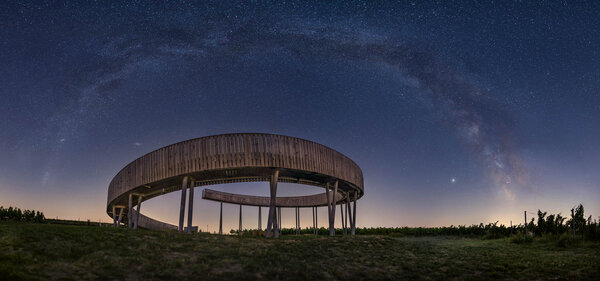
Kobylí vrch lookout tower, architects: Jiří Vojtěšek and Jakub Roleček
Why it matters: the author's rights live alongside ownership of the building
Whether a building is a copyrighted work is not an academic question. If it is a work, the architect acquires copyright that exists independently of the ownership of the building. Copyright is divided into economic and moral rights. Moral rights, which include the right to the integrity of the work, are non-transferable and the author cannot waive them. That is precisely why an architect can have a say in changes to the building even many years after it was created, including against an owner who bought it from someone else.
Moreover, economic rights last for the entire life of the author and a further 70 years after their death. The fact that a building is a copyrighted work can thus affect several everyday situations: the renovation and change of a completed building, the use and modification of an architectural study, and the purchase or sale of a property. We examine these topics in separate articles, Renovating a property as a change to a copyrighted work and I paid an architect for a project - can I build from it and change it?.
Frequently asked questions
Is every building a copyrighted work?
No. Only a building that is a unique result of the architect's creative activity - that is, one with an individual architectural or urban-planning solution - is a copyrighted work. An ordinary standardised, purely functional or technically predetermined structure (for example a simple hall or a catalogue family house without creative treatment) is usually not a copyrighted work. What decides is always the specific assessment, not the size or price of the building.
What does copyright actually protect in an architectural work?
Protection covers not only the finished building but also the way it is expressed - the architectural study, design, drawing, plan and model. The Copyright Act protects an architectural work regardless of the form in which it is captured. By contrast, the mere idea, functional solution, structural principle, or elements dictated by technical or legal requirements are not protected - protection concerns the specific creative rendering, not the general idea.
Who is the author of an architectural work and how does copyright arise?
The author is a natural person - the architect who created the work. Copyright arises upon the very creation of the work, without registration or marking. If several architects create the work together, it is joint authorship. For a work created by an employee (an employee work), the economic rights are usually exercised by the employer, but the moral rights remain with the author. Note - the owner of the building and the author of the design are two different persons with different rights.
How long does copyright in a building last?
Economic copyright lasts for the entire life of the author and a further 70 years after their death; only then does the work become free. This means that even for older buildings standing for decades, copyright may still be alive - including against an owner who bought the building from someone else. Before renovating, converting or demolishing an architecturally valuable building it is therefore prudent to verify whether, and to whom, copyright in it belongs.
Wondering whether your building is a copyrighted work and what rights and risks follow from it? Get in touch with us.
In intellectual property as well as real estate law and property transfers we will assess whether a specific building enjoys copyright protection, address the licensing arrangements in the contract for work and when buying a property, and, if needed, negotiate the architect's consent to changing the building. Before you sign anything or start demolishing, contact Preegal law firm and discuss your plan with us.